Monday, March 3, 2014

Aliceville Alabama Train Wreck Site 4 month update


Aliceville Alabama Train Wreck Site 4 month update.

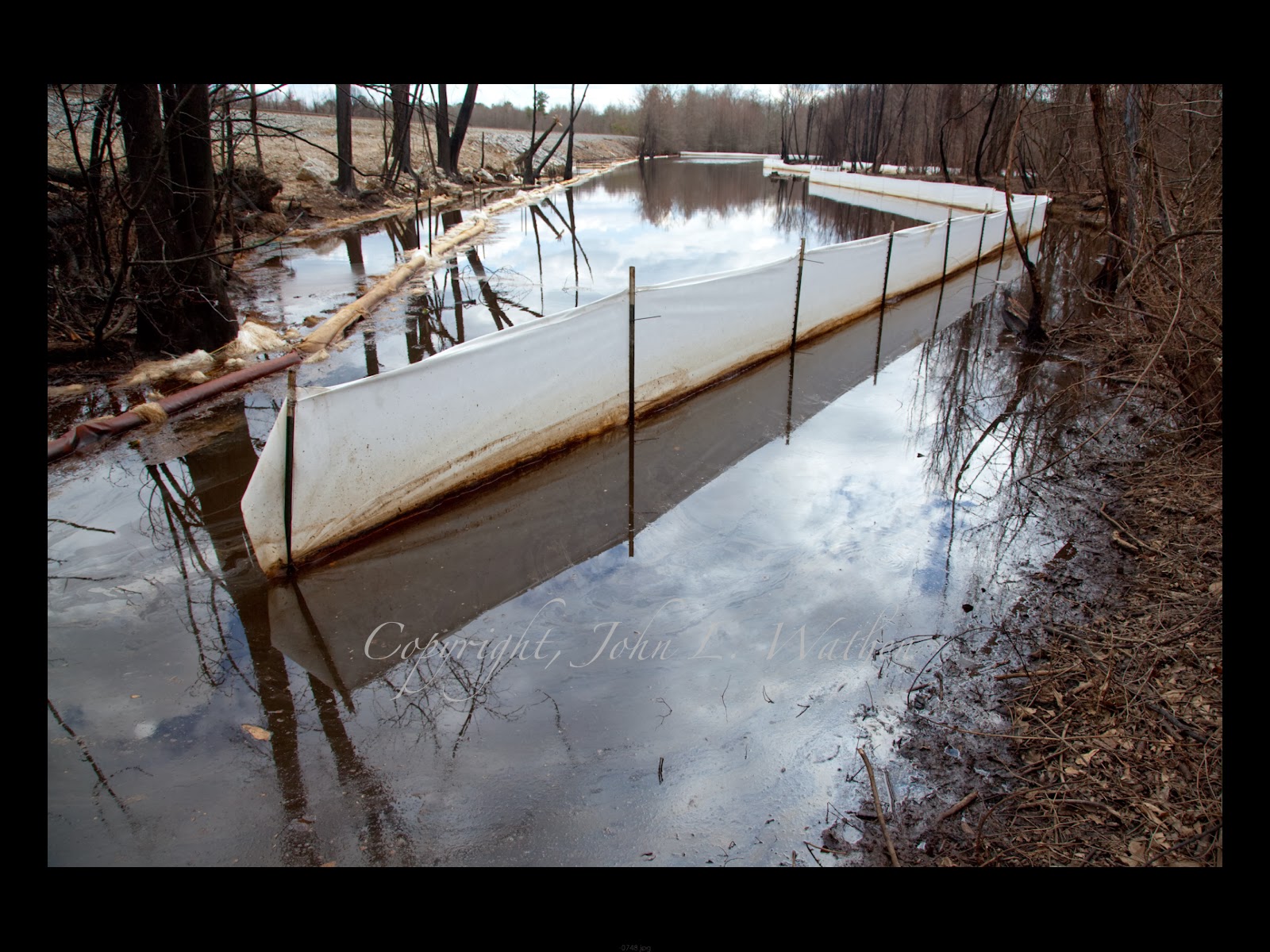
A train carrying Bakken Crude derailed just outside Aliceville Alabama on Nov. 8, 2013. This video and subsequent photos were taken and edited 03/02/14, 4 months after the wreck. Nothing here resembles ongoing oil removal as proclaimed by Lance LeFleur, ADEM Director, on Dec.09, 2013.


At the South Providence Church Road, there was sheen visible and weathered oil in the wetland upstream from the road.
At the Railroad wreck site, I found some new boom had been installed but it was the same old inefficient white boom and oil screen. Much of it was already saturated.
As with any product, the efficiency is greatly diminished when it isn't installed and maintained properly. In this case, the oil screens were down, not properly secured, and not all inclusive of the site.


Much of the white boom was in similar condition with some of it completely saturated. Oil was weeping out of the ground on both sides of the tracks.

Some of the boom looked as if it had never been changed or removed. Much of it was completely saturated and sunken in the swamp. Once it has absorbed all it can, it should be removed and new product installed. If not, it just gives off the oil it absorbed back into the water. The sunken boom seen below has been there since the "cleanup" began 4 months ago.
Weathered oil was present in all areas. That indicates no oil removal for some time. According to Lance LeFleur, Director of ADEM (Alabama Dep. of Environmental Maniacs) in a letter to the ADEM Commission on Dec. 09, 2013.
"Aggressive recovery operations are ongoing".


Wednesday, February 26, 2014

Rail cars used to ship oil called 'unacceptable'

Rail cars used to ship oil called 'unacceptable'

DOT-111 cars on bridge over Black Warrior River (photo by JLW)
WASHINGTON (AP) — A federal safety official says the rail tank cars being used to ship crude oil from North Dakota's Bakken region are an "unacceptable public risk," and even cars voluntarily upgraded by the industry "may not be sufficient."

National Transportation Safety Board member Robert Sumwalt told a House subcommittee Wednesday that the cars, known as DOT-111s, were involved in derailments of oil trains in Casselton, N.D., and Lac-Megantic, Quebec, just across the U.S. border.
The NTSB has long urged replacement of the tank cars, but federal efforts to write tougher regulations for new tank cars have dragged on for two years.
Cynthia Quarterman, head of the federal hazards materials safety administration, said she expects to propose new rules this year. She had no estimate for when the rule would be final.


Monday, February 3, 2014

New Augusta Mississippi, crude train wreck


 Train Wreck... No Explosion! 


I want to use the recent train derailment in New Augusta Mississippi on Jan. 31, 2014 to make a comparison between tar sands oil and Bakken Crude oil. In no way am I supporting the use of tar sands over Bakken. Please take this for it's intended purpose which is to highlight the extreme dangers of Bakken crude on the rials outside America's bedrooms.
Photo by news.nationalpost.com
Aliceville Alabama 11/14/13
 In Miss. 18 cars left the track carrying Canadian tar sand oil. 
 
Some were punctured and others were ripped, but none exploded.

 Oil was lost into the drainage ditch leading to the Leaf River but was fairly well contained.

 There was no fire, or explosion.

In the last 4 derailments of Bakken crude there were horendeous explosions and fires that have killed 47 in Canada while dumping thousands of gallons of toxic Bakken crude oil into surrounding streams and wetlands, such as Aliceville Alabama.  Then there was Caselton Nd. where two trains collided and went up in mushroom cloud explosions. Derailments or collisions, Bakken crude react differently from any known hazardous crude oils.

This one was carrying Canadian tar sands oil and Methanol. The Methanol being the fire danger. Tar sands for the most part are very thick and must be shipped in insulated and sometimes heated cars.
Most of the oil from this wreck hit the cold ground and turned to a heavy syrup like consistency without spreading too far away from the site.

 Some did reach the median of Hwy 98 but it too looked to be contained for the most part.
Oil sheen on water was contained. Needed Opflex deployed.

Side drains along the Hwy were stopped up using tarps and truck loads of sand. not much chance of it leaving the area without an extreme rainfall event.

 The main drainage along the tracks was filled wit "crusher run", a finely ground gravel that packs tightly and serves as a temporary dam. This held the oil in the immediate area where it could be dealt with.

 There was a pumping operation next to the road where I saw several trucks coming and going.  
Some were pumping what looked to be crude oil from right along side the road.
Others were cleaning out tank cars of Methanol. 

D.O.T. Placard 1230 Methanol, Flammable Liquid, Class 3.DOT PLACARD 1230 METHANOL, Flammable Liquid, Class 3 - Choose from 4 Materials: Pressure Sensitive Vinyl, Rigid Plastic, Aluminum or Magnetic 
I saw pump trucks coming and going from the tank cars that didn't show placards at all. I know it was crude oil but no why placards on the highway?
I don't know ht made me take the turn in Meridian down a back street after getting gas but I found it kind of ironic that trains were sidelined due to the wreck I was going to report and I was driving by the potentially the next one.
Meridian Mississippi 02/01/14


DOT PLACARD 1987 ALCOHOLS, DENATURED ALCOHOL, Flammable Liquid, Class 3 - Choose from 4 Materials: Press On Vinyl, Rigid Plastic, Aluminum or Magnetic
DOT PLACARD 1987 ALCOHOLS, DENATURED ALCOHOL

D.O.T. Placard 1987 Alcohols, Denatured Alcohol, Flammable Liquid, Class 3. 

Will we ever learn? 
While the NTSB studies the Bakken debate, we, the people need to be sounding off. We should be demanding new and tougher restrictions on train cars and all methods of transferring this extremely unstable product.
LAC-MÉGANTIC, Que., Canada